Digitalisation & Compliance
Electronic Invoicing between businesses
What will change in Luxembourg by 2028, and most importantly: how you will actually receive invoices from your suppliers.
The essentials in three points
On 17 July 2026, the government approved a bill extending the mandatory use of electronic invoicing, currently limited to public procurement, to transactions between businesses established in Luxembourg. The text remains a draft law: the announced dates have not yet been definitively approved.
Transactions will take place through the European Peppol network, which is already used for invoices sent to the public sector.
An electronic invoice is not a PDF sent by email: it is a structured file that can be automatically read and processed by accounting software.
The topic covers two distinct flows: the issuance of your sales invoices and the receipt of your supplier invoices. The latter, which is the more complex part, is what we handle for you.
The announced timeline
1 January 2028
All businesses will be required to be able to receive electronic invoices.
1 July 2028
Mandatory issuance of electronic invoices for medium-sized and large businesses.
1 January 2029
Mandatory issuance extended to all businesses.
Comment circule une facture électronique ?
The Peppol network operates according to the “four-corner model”. Each business remains connected to its own service provider, known as an “access point”, and the access points communicate with each other.
The sender and recipient never connect directly.
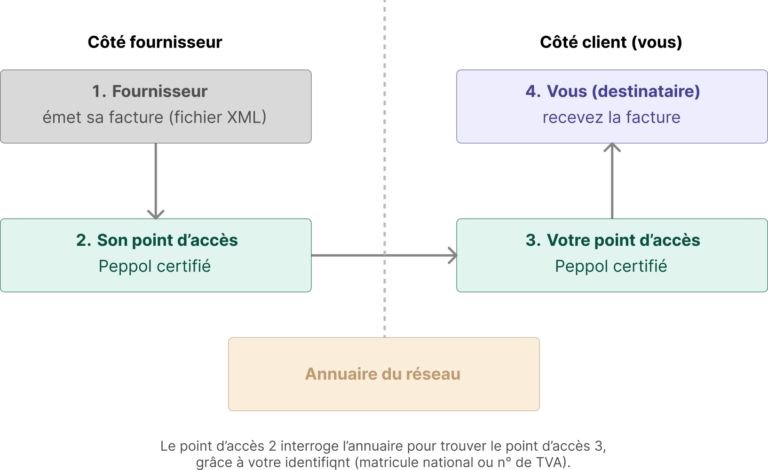
Routing is automatic: there is no direct exchange between the supplier (1) and you (4).
Two flows not to be confused
These are the invoices that you send to your customers. You will need to be able to issue them in a structured electronic format through the network.
The only question that concerns you here is: do you have an invoicing tool that can be connected to the network? If so, we will check its compatibility. If not, we will guide you towards a simple solution adapted to your volume.
This is the point that is most often overlooked. Receiving a supplier invoice is not enough: it also needs to be integrated into your accounting system so that it can be checked, recorded and paid.
For this flow, you do not need to install or manage anything. As your fiduciary, we already handle your accounting: your supplier invoices are received through our platform and directly integrated into your accounting file. They reach us ready to be processed.
This is not just theory: it is already the model used in Belgium.
Since 1st January 2026, B2B electronic invoicing has been mandatory in Belgium, using the same Peppol network. The obligation applies to both issuing and receiving invoices. In practice, supplier invoices received by businesses are largely processed through their accounting firm's platform, with the invoices directly integrated into their accounting system. This is exactly the approach we are putting in place for you.
The Peppol network is stable and proven (it is already used by the public sector and has been used in Belgium since 2026). In Luxembourg, several aspects of B2B electronic invoicing still depend on legislation yet to be published. We are monitoring these developments and will adapt the solution to your organisation.
Frequently Asked Questions
Is a PDF sent by email sufficient?
No. Under the applicable regulations, an electronic invoice is a structured file transmitted through the network that can be automatically read and processed by software. A PDF, even when sent by email, is not compliant.
What is Peppol?
A common European delivery network that enables the automated issuance, transmission and receipt of electronic invoices. In the digital world, it acts like a standardised and interoperable mailbox.
How does the network know where to deliver my invoice?
Each recipient is registered in a directory using a unique identifier — in Luxembourg, the national identification number or VAT number. The sender’s access point queries this directory to route the invoice to the correct access point.
Who handles the receipt of my supplier invoices?
We do. As we handle your accounting, your supplier invoices are received through our platform and directly integrated into your accounting file. You do not need to install or configure anything on your side.
Is my invoicing software not enough?
Invoicing software is used to issue your sales invoices; it does not necessarily support the receipt of supplier invoices, and above all, it may not integrate them into your accounting system. Issuing and receiving invoices are two distinct functions: we check your invoicing software and manage the receipt of your supplier invoices for you.
Do I need to get new software?
For receiving invoices, no: we take care of it. For issuing your sales invoices, it depends on your current invoicing software and its compatibility with the network. If a new solution is required, we will guide you towards one that is suited to your business volume.
How long do I need to keep invoices?
Keeping invoices comes with requirements for authenticity, integrity and readability throughout the entire retention period. The specific requirements under the B2B regime will be confirmed by the final legislation.
A grant can help finance your compliance efforts.
The transition to electronic invoicing is a digitalisation project and may therefore benefit from public funding.
SME Packages from the Ministry of the Economy
This scheme can cover up to 70% of eligible costs for a digitalisation project, subject to eligibility requirements. The project must fall within a defined cost range, and the grant is paid after implementation: the company pays the costs upfront and is then reimbursed.
Eligibility and the grant amount depend on your specific situation. We will assess this with you and, where applicable, prepare the grant application.
General information about the current scheme; the specific eligibility requirements are assessed on a case-by-case basis.
Let's prepare for this transition together!
As your fiduciary, we already receive and process your invoices. We are therefore best placed to prepare your transition in line with your accounting, without waiting until the deadline.
OmniTrust, your partner at every stage of your business.
Creation, Incorporation & Formalities
Investor Visa, Relocation & Business Setup
Structure your investments
Holding Companies, SOPARFI, SPF & Wealth Structuring
Accounting, Annual Accounts, Tax Returns & Reporting
VAT, Taxation & Tax Returns
Payroll, Employment Contracts & Social Security Declarations
Dissolution, Voluntary or Compulsory Liquidation
Let's talk about your projects