
Since September 21, 2026, Luxembourg Business Registers (LBR) has been gradually rolling out the enforcement phase of its procedure for verifying the data recorded in the Trade and Companies Register (RCS) and the Register of Beneficial Owners (RBE). This phase targets entities that have failed to meet their filing obligations. Non-profit associations and foundations are excluded for now.
The first registered letters requesting compliance are now being sent to the companies concerned.
Business leaders need to be especially vigilant: an administrative irregularity can have financial, banking and commercial consequences.
Why is the LBR stepping up its checks?
The law of January 23, 2025, which came into force on February 1, 2025, strengthened the supervisory powers of Luxembourg Business Registers. After an awareness-raising period, the LBR launched its sanctions phase on September 21, 2026. The aim is to improve the reliability and accuracy of the information held in Luxembourg's official registers.
According to reports in the Luxembourg press, nearly 60,000 files showed at least one breach of filing obligations as of August 31, 2026.
Which irregularities are involved?
The most common breaches include:
• Failure to file annual accounts.
• An incorrect or incomplete registered office address.
• Outdated appointments of managers or directors.
• Missing or inconsistent beneficial ownership information.
When an irregularity is identified, the LBR may send a registered letter titled "Request for verification and update" (Demande de vérification et de mise à jour). This letter specifies the items that need to be corrected.
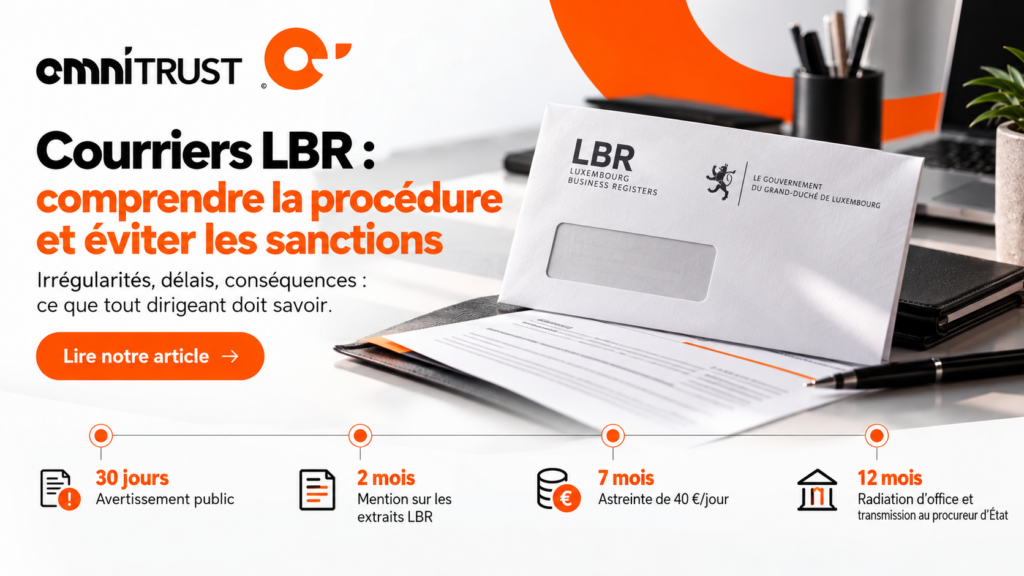
The company has an initial period of 30 days from the date the registered letter is sent to make the requested corrections. Failure to actually receive the letter does not necessarily suspend the procedure.
What is the timeline for sanctions?
If the situation is not corrected, the procedure provides for several escalating measures:
• From the first day of the second month after the letter is sent: publication of a warning on the LBR website.
• From the first day of the third month: the breaches are noted on certificates issued by the LBR.
• From the first day of the seventh month until the last day of the ninth month: a possible penalty of €40 per day, up to a maximum of 90 days.
• From the first day of the twelfth month: possible ex officio removal from the register, without dissolution of the company. The file may also be referred to the State Prosecutor.
The penalty can amount to €3,600. Ex officio removal does not result in the dissolution of the entity or the loss of its legal personality. It can nevertheless cause significant practical and commercial difficulties. The measures may be appealed in accordance with the procedures and deadlines set out in the applicable legislation.
The company can correct its situation at any stage of the procedure. Full regularisation ends the procedure and lifts the measures taken, without prejudice to any penalties already incurred.
Beyond sanctions: a risk to banking and business relationships
RCS extracts are routinely used by banks in their know-your-customer (KYC) procedures, as well as by investors, business partners and potential buyers.
An irregularity appearing on an official extract may raise questions when opening a bank account, applying for financing, carrying out an investment, acquiring or selling a business, or undergoing a compliance check by a partner.
A missed administrative obligation can therefore become a strategic risk for the business.
Are domiciled companies affected?
Yes. Being domiciled does not exempt a company from its legal obligations. However, when a company is domiciled with a service provider that handles its mail, it benefits from an arrangement that makes it easier to keep track of official correspondence.
At Omnitrust, we receive the mail of companies domiciled with us and inform the clients concerned when action is required. Regularisation may then require additional documents or information from the company's directors.
What steps should you take?
1. Check the registered office address recorded in the RCS.
2. Verify that the annual accounts have been filed.
3. Check the information about the company's directors and managers.
4. Make sure the RBE entries are accurate.
5. Forward any letter received from the LBR to your account manager without delay.
How Omnitrust supports businesses
Our teams help businesses meet their accounting and administrative obligations. If you receive a compliance letter, we can review the irregularities reported, identify the documents required, prepare the regularisation formalities and support you in your dealings with the LBR.
Have you received a letter from the LBR, or would you like to check your RCS or RBE file? Contact your Omnitrust account manager to review your situation.
Sources: Luxembourg Business Registers, public notice of September 9, 2026; law of January 23, 2025; amended law of December 19, 2002.
This article provides general information and does not constitute legal advice tailored to any particular situation.